
Since the downfall of so many voluntary support organisations, I’ve found myself delivering a lot of Trustee training: via zoom, in person, even developing videos for long term Trustee induction.
And I generally start off with the Trustee duties: the responsibilities that cannot, must not, will not be delegated to anyone else.
“Ah yes”, you might say. “I remember reading something about those. Six sentences in the Charity Commission guidance documents, it’s that right?”
Not quite.
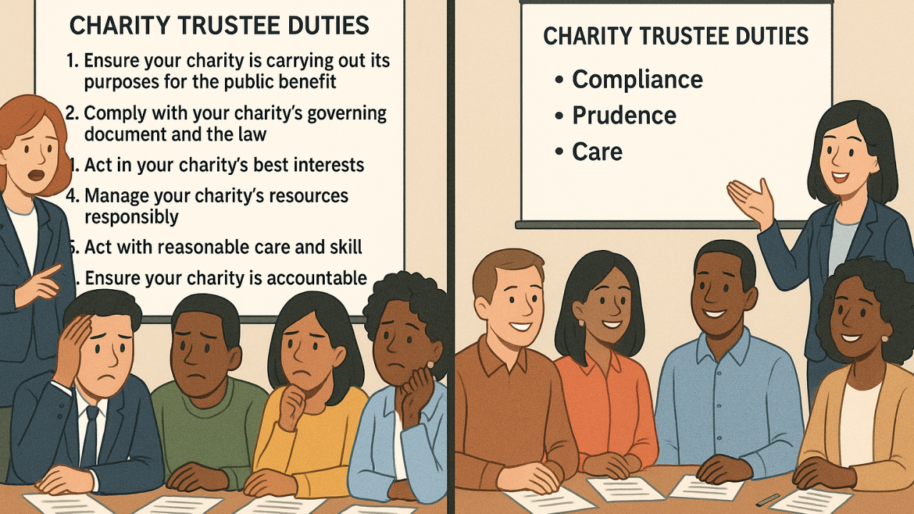
Legally speaking, there are three duties: the Duty of Compliance, the Duty of Prudence and the Duty of Care.
- Compliance is the duty to comply with the governing document and all applicable laws, as well as to manage conflicts of interest appropriately.
- Prudence is the duty to act with caution, proportionality, and good judgment, not just in financial terms (although this is important) but with everything else as well.
- Care is the duty to act with reasonable care and skill, covering everything from turning up to investing adequate time to seeking advice when it’s needed.
Shut your eyes now and try to see if you can remember these off the top of your head – just the three headings of Compliance, Prudence and Care.
Could you?
Hopefully, you could, because they’re simple. They’re memorable. They’re words we know and can connect to the details that lie beneath them.
The Charity Commission, in its infinite wisdom, and followed by almost every guidance document I can find, has extrapolated out these three legal duties into six duties. I believe this is intended as an attempt to help Trustees understand them.
These are longer, yet not as comprehensive:
1. Ensure your charity is carrying out its purposes for the public benefit
2. Comply with your charity’s governing document and the law
3. Act in your charity’s best interests
4. Manage your charity’s resources responsibly
5. Act with reasonable care and skill
6. Ensure your charity is accountable
Now, shut your eyes and see how many of these you can remember off the top of your head.
Not many, right?
Six is too many to remember, and each sentence is different, disparate and wordy.
The three duties are easy to remember. Three words, each of which clearly connects to what Trustees are legally expected to do.
Understand what compliance means? You’ll understand it includes following your charity’s constitution, but also health and safety law, safeguarding regulation, employment legislation, and charity law itself.
Know what it means to be prudent? You’ll understand you’re being trusted with your charity’s assets and must act responsibly, avoid unnecessary risk, and not overcommit. You’ll need to make decisions sensibly, not rationally or irresponsibly.
And care? That’s a broad word, but so is the duty. It demands diligence, preparation, applying your skills and experience, and taking the role seriously. (And reading the papers. Let’s not forget reading the papers. There is a special place in hell for Trustees who don’t read the papers.)
Compare that to the six in the Commission’s guidance. They’re longer, more operational, and harder to hold in your head. I’ve read them a thousand times, I’ve mentioned them in passing during training a thousand more, I still couldn’t give you all six from memory. Not because they’re irrelevant, but because they’re not fundamental.
What’s worse is I don’t feel like they’re sufficiently comprehensive. These are complex, important duties, and I don’t think that the six principles achieve the same result as the original three.
It’s not that the Commission’s six are wrong. They’re fine as guidance. But that’s what they are: guidance. Not the legal duties.
I want Trustees to understand their role legally and structurally, not just operationally. Their duty is not just to be ‘lovely people doing lovely things’ as the outgoing Chair of the Commission would have us believe. It’s to discharge a legal responsibility.
The structure of the charity sector is flawed and broken. I do enough governance reviews and crisis projects to say that with great confidence. Being a good Trustee is hard.
In that context, we particularly need Trustees to understand their duties, in all their glory. And to be able to recall them, and apply them as and when challenges arise.
Despite my regular criticism of the Charity Commission, the one thing I think they do well is their guidance. But on this front, I think they’ve missed something by removing any reference to the three legal duties, and not explaining that their six is extrapolated from the original legal three.
I’ll continue to do what I do: mention the six, but teach the three.
Compliance. Prudence. Care.